Cute Sea Animals Font for Branding and Creative Projects
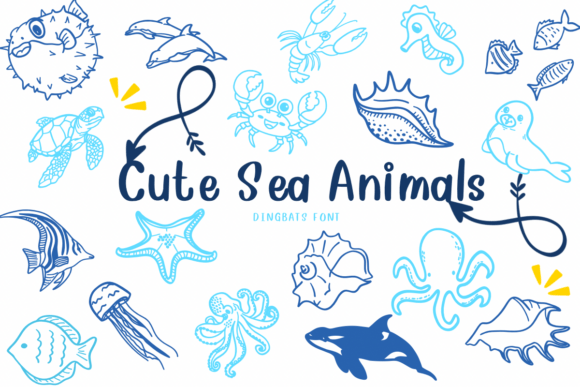
I was staring at a blank brand board for a new local café project, feeling a bit stuck. The brief called for something coastal, welcoming, and family-friendly. My usual typeface suspects were feeling too generic. Then I downloaded Cute Sea Animals. Suddenly, instead of just thinking about letterforms, I had a playful dingbats font featuring a delightful collection of hand-drawn ocean creatures at my fingertips. From whales and jellyfish to crabs, turtles, and starfish, each glyph captured that specific charm I needed.
Using Cute Sea Animals Fonts in Logo Drafts and Signage
My first test was dropping a few glyphs into a logo sketch. Cute Sea Animals isn’t a standard text font; it’s a library of individual characters. This meant I could treat each creature as a modular design asset. I replaced the usual circular dot in the café’s name with a tiny, smiling turtle. For the secondary mark, a simple whale outline became the perfect anchor icon. The hand-drawn style meant the lines were friendly and imperfect, which immediately softened the entire brand’s visual tone. It felt less like a rigid logo system and more like a handcrafted identity.
Cute Sea Animals Dingbats for Packaging and Product Labels
Moving to packaging mockups, the flexibility of these dingbats really shone. For a series of honey jars the café planned to sell, I used the crab glyph as a repeating pattern around the lid’s label. On the main label, I paired the café’s name in a clean sans-serif font with a single starfish dingbat from the Cute Sea Animals collection, placed like a seal or stamp. The result was cohesive without being overwhelming. The dingbats acted as illustrative accents, not the primary text, which is exactly how a font like this should function in complex branding.
How Cute Sea Animals Enhances Social Media Graphics
For social media templates, consistency is key but boredom is the enemy. Cute Sea Animals gave me a quick visual vocabulary. A jellyfish could subtly adorn a post about a new smoothie. A crab might peek out from a corner of an announcement graphic for a seafood event. Because each glyph captures the charm of the sea, they carried the brand’s coastal theme into every Instagram post or Facebook banner without needing custom illustrations each time. This saved hours in the design phase and created a recognizable, playful thread across all digital touchpoints.
The personality of these fonts is inherently joyful and approachable. When you use Cute Sea Animals in branding, you’re borrowing that mood. It signals a brand that is light-hearted, possibly artisanal, and certainly not corporate. For the café project, this was perfect. It helped the visual identity communicate “family-friendly spot” before a single word was read.
Pairing Cute Sea Animals with Other Typefaces
A dingbats font like Cute Sea Animals almost always needs a partner. For primary text, you need clarity. I paired it with a sturdy, neutral sans-serif for menus and body text on the website. For more elegant moments, like a special event menu, I used a light serif. The dingbats became the playful counterpoint, providing visual interest and thematic reinforcement. The key is to let the dingbats accent, not dominate. They are supporting actors in your typography cast, and when used sparingly, their impact is much greater.
Testing Cute Sea Animals Fonts in a Full Brand System
Before committing, I tested the glyphs across all the required materials. How did that whale look etched onto a wooden sign mockup? Did the turtle scale down cleanly on a business card? Was the jellyfish too detailed for a small web icon? Cute Sea Animals passed because the hand-drawn lines were clear and bold enough to remain identifiable at small sizes. This practical test is crucial. You need to see your chosen dingbats in every context—print, digital, large, small—to ensure they perform.
For this kind of dingbats font, licensing is also a practical consideration. Since this was for a commercial client’s branding, I confirmed the font license allowed for use in logo design, packaging, and all commercial marketing assets. A font like Cute Sea Animals becomes a core part of the brand’s visual assets, so its license must cover that usage.
Cute Sea Animals for Merchandise and Editorial Accents
Beyond the core branding, these glyphs become a treasure trove for merchandise. I used the starfish and turtle dingbats to create simple repeat patterns for apron designs and tote bags for the café. In editorial design, like the café’s monthly newsletter, a crab dingbat could mark the “Fresh Catch” section, and a whale could denote the “Big News” column. This turns functional text sections into subtly branded moments.
The real value of Cute Sea Animals is in its delightful collection. You aren’t getting one or two icons; you’re getting a whole underwater cast. This allows for variety within consistency. You can use different creatures for different product lines or service categories under the same brand umbrella, all while maintaining a unified hand-drawn style.
Why Cute Sea Animals Dingbats Work for Niche Brands
This approach isn’t just for cafés. A skincare brand with ocean-inspired ingredients, a handmade shop selling coastal pottery, or a creative studio with a marine biology focus—all could leverage this specific dingbats font. The charm captured in each glyph speaks directly to audiences interested in those niches. It’s a visual shorthand that builds immediate affinity.
In the final materials for the café, Cute Sea Animals provided the gentle, illustrated texture that made the brand feel personal and crafted. The signage, menus, labels, and social graphics all carried a whisper of the sea through these small, charming characters. The project reminded me that sometimes the most impactful branding elements aren’t the big, bold logos, but the small, repeated accents that tell a story. Cute Sea Animals, as a playful dingbats font, gave me exactly that: a story of whales, jellyfish, crabs, turtles, and starfish, ready to be woven into a brand’s world.